City of Amsterdam
How can cities plan for the spatial impact of the circular economy? We assessed the spatial claim of essential circular activities in different value chains (e.g., building with wood, or reducing consumption of new electronics) and how cities can ensure space exists for these activities to flourish.
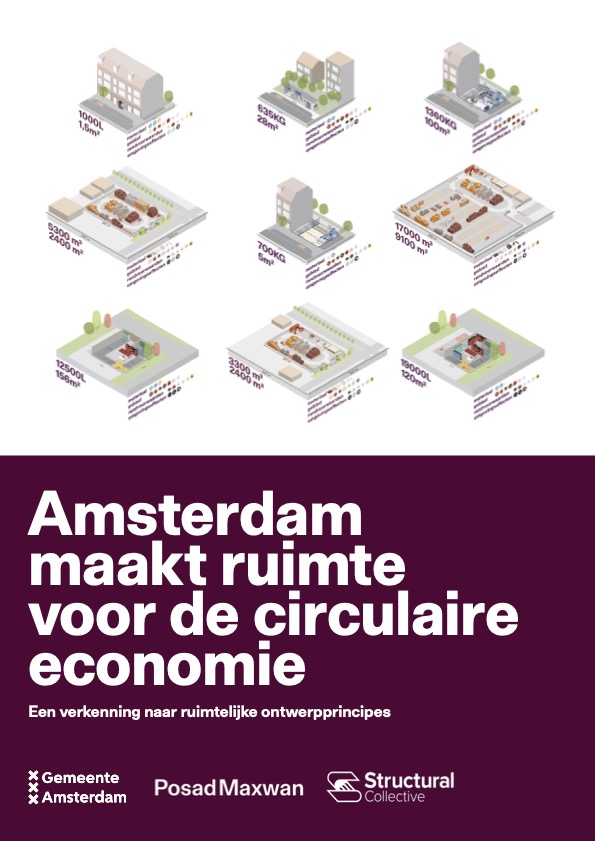
Any data available for download is released under CC BY-SA 4.0.
Research into the Spatial Implications of the Circular Economy in Amsterdam - PosadMaxwan and Structural Collective, conducted a study to map out how much space the circular economy requires and how its functions (such as recycling, storage, manufacturing, repair, and circular construction) can be integrated into the city.
An analysis was made of relevant sectors (built environment, consumer goods, food & organic waste streams) and their value chains. Criteria were established for strategic locations in the city (ports, business parks, urban fringes, multimodal hubs, etc.).
Using PBL (Netherlands Environmental Assessment Agency) scenarios, possible development directions were explored. For the different links in the value chains, "spatial passports" were developed outlining requirements, preconditions, and spatial claims.The work resulted in a list of the most important opportunities for the circular economy in Amsterdam, including spatial preconditions and initial policy measures.
Seven circular opportunities were further elaborated with maps, material flows, typologies of value chain links, and concrete integration into the city. Each opportunity was tested with involved "champions" or owners.
Additional contributors:
Dafni Vlachou, Jorrit Vervoordeldonk