European Union (LIFE) / City of Amsterdam
Implementation of biobased insulation in 566 monumental dwellings and one iconic market hall. The LIFE BIOMATINE project will be a showcase in pilot projects in Amsterdam of the potential of biobased building materials .
.png)
Any data available for download is released under CC BY-SA 4.0.
Structural Collective is a partner of LIFE BIOMATINE, an initiative by Gemeente Amsterdam. From July 2025 to June 2031, this collaborative project will demonstrate that biobased insulation materials are well suited for improving the energy performance of historic, social housing and monumental buildings. At the same time, it aims to create a positive sustainability impact on both the agricultural and construction sectors.
In short
LIFE BIOMATINE promotes the use of natural, biobased insulation materials in historic, social housing and heritage buildings. This contributes to a circular economy, reduces the use of fossil energy, and helps cities adapt to climate change. The project will demonstrate this at two locations in Amsterdam.
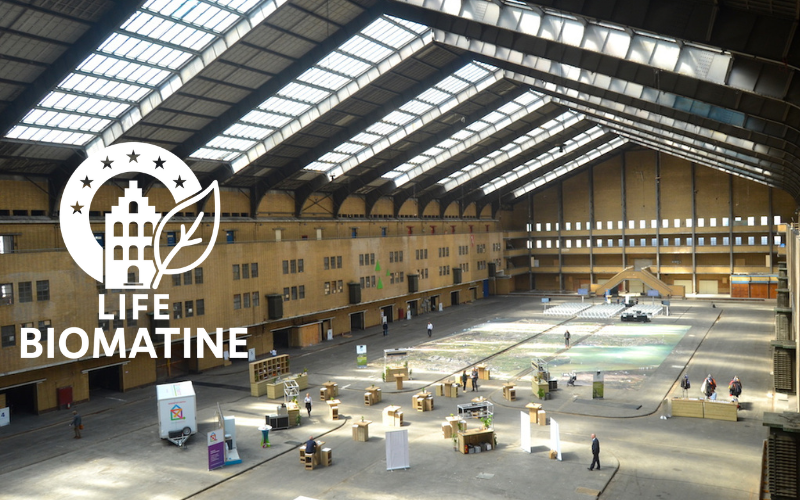
The goal is to make the Tasmanblokken in the Spaarndammerbuurt (557 mainly social housing units) and the Central Market Hall more sustainable. Insulating the social housing units alone is expected to avoid 965 tons of CO₂ emissions, equivalent to 7,780 return flights from Amsterdam to London. In addition, the annual energy use of residents will be reduced by 2.5 GWh, enough to supply electricity to 1,000 households for a year.
Knowledge products, such as training programs and practical tools, will help share the lessons learned with professionals in the construction sector. The two pilot sites and these knowledge products are intended to inspire other public and private property owners in the Netherlands and across Europe to switch to biobased insulation as well. This way, the use of these currently underutilized materials can be scaled up.
The experts
This project is a collaboration between:
- Woonstichting Lieven de Key, owner of the 557 social housing units
- BOEi, manager of the Central Market Hall
- De Groene Grachten, advisor for sustainable heritage renovation
- Building Balance, advisor and executor of the national biobased construction program
- Gemeente Amsterdam, project coordinator
Structural Collective is a research and advisory firm committed to shaping cities that thrive within planetary boundaries. Within LIFE BIOMATINE, we are responsible for making the knowledge gained from the pilot projects widely accessible.
Structural’s commitment involves developing an impact monitor, evaluating the potential of biobased insulation materials throughout Europe, and disseminating knowledge to property portfolio owners, housing associations, and municipalities. We do this in our role as researcher, sustainability advisor, and work package leader.
To achieve these goals, we collaborate closely with other project partners. Together with De Groene Grachten, we implement the lessons learned in at least ten other projects. With Building Balance, we ensure that knowledge and experience are scaled up across Europe.
EU LIFE Programme
The European Union aims to become a climate-neutral continent with a fully circular economy by 2050. By 2030, it targets a 55% reduction in CO₂ emissions compared to 1990 levels and a 50% reduction in the use of primary abiotic materials. The LIFE BIOMATINE project contributes to both the EU’s climate and circular economy goals.
Funding for the project comes from the LIFE and Environment Programme of the European Commission. This programme supports initiatives in the areas of nature and biodiversity, circular economy, climate adaptation, and energy transition. The total project budget is €7.5 million, of which the EU has committed €4.5 million in funding.
More information
All current information can be found at: LIFE BIOMATINE openresearch.amsterdam. For questions, please contact Harmen Heida or the project manager at the City of Amsterdam, Daan Jongejan (daan.jongejan@amsterdam.nl).
Disclaimer
Funded by the European Union. Views and opinions expressed are however those of the author(s) only and do not necessarily reflect those of the European Union or the European Climate, Infrastructure and Environment Executive Agency (CINEA). Neither the European Union nor the granting authority can be held responsible for them.
Image: Interior of theCentrale Markthal. Credits: Eriksw, CC BY-SA 4.0, via Wikimedia Commons