City of Amsterdam
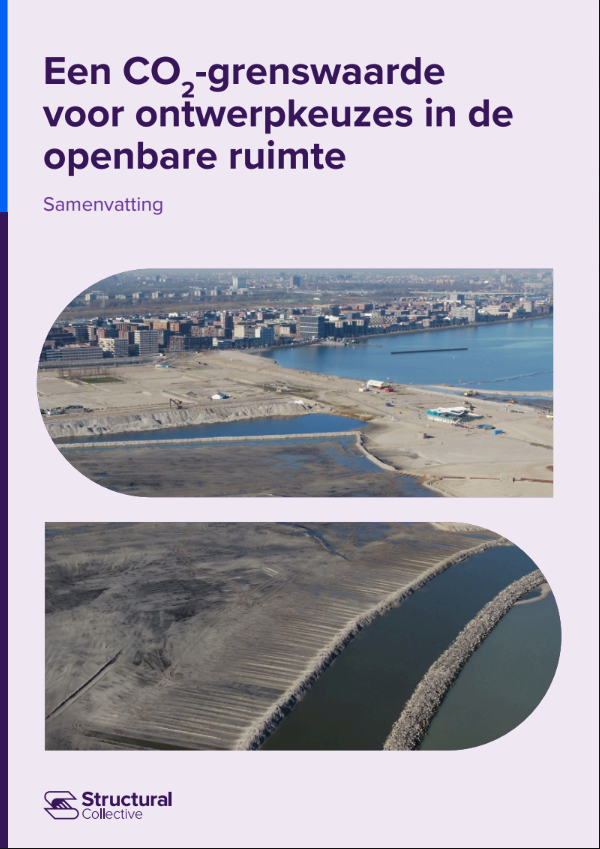
Based on Amsterdam’s climate targets and the Paris Agreement, we have set a CO₂ threshold per square metre to reduce the environmental impact of the paving on Strandeiland.
Any data available for download is released under CC BY-SA 4.0.
Background and relevance
In 2024, the Municipality of Amsterdam expanded its climate strategy to include ambitious reduction targets for indirect emissions, also known as Scope 3 emissions. Indirect emissions account for a large proportion of the municipal organisation’s CO₂ emissions, often relating to the procurement of materials for its own property portfolio and public spaces. Within area development projects, the municipality therefore wishes to take a more proactive approach to promoting sustainable material choices, in line with the Scope 3 targets.
Research question
“How can we establish a CO₂ limit for pavements that is aligned with our climate ambitions?”
Applying the limit value: Strandeiland as a case study
To translate the objectives to the project level, in our study commissioned by the City of Amsterdam on the large-scale area development at Strandeiland, we have established a CO₂ threshold per square metre. A limit value is a concrete benchmark that enables designers to steer towards sustainable material choices in public spaces right from the design stage. If a material’s emissions remain below this value, it is in line with the set climate target. This encourages discussion about the necessity of using materials, the evaluation of alternatives, and the accountability of procurement decisions.
Key findings and recommendations
- Our research shows that the limit value is unachievable for new pavements using conventional materials.
- To remain within the limit values, the municipality will need to redesign public spaces in a fundamentally different way. Reducing the construction of new pavements will yield the most CO₂ savings.
- In addition, investment is needed in circular solutions for pavements and public spaces to reduce CO₂ emissions per square metre.
- Large-scale CO₂ reductions in other sectors ensure that the necessary construction of paved surfaces for a well-functioning public space remains possible. Political decisions are required to achieve this.
- As there is no margin in the current budget for new paving, this leaves little room for manoeuvre for designers. To provide designers with scope for action, the threshold value could also be linked to the 1.7 and 2.0 degree warming scenarios.